Gas springs are critical damping and motion-control components engineered for rigorous applications across automotive components, office furniture, medical equipment, and heavy industrial machinery
In early 2024, introduced by our dedicated machinery sales agent in Turkey, we began collaborating with one of the country's most prominent industrial manufacturing enterprises
As their global order volume expanded, the client sought an intelligent solution to eliminate bottlenecks in cutting and deburring small carbon steel pipes
Prior to introducing automation, the client’s factory operated over 30 sets of traditional circular saw blade cutting machines and stand-alone pipe chamfering machines
Their conventional manufacturing process was heavily segmented:
Mechanical Cold Sawing: Carbon steel pipes were cut to specified lengths using conventional saw blades
Intermediate Bin Buffering: Cut pipes accumulated in metal storage crates across the workshop floor
Manual Transfer to Chamfering: Factory operators manually carted batches to individual chamfering machines for end-facing and secondary edge deburring
Excessive Labor & Handling Hazards: Several operators were tied down purely with material loading, unloading, and inter-station handling
High Tooling & Consumable Expenses: Saw blades degraded quickly against carbon steel, incurring high monthly replacement and sharpening expenses
Floor Space & WIP Clutter: Managing intermediate storage for 30+ separate machine stations consumed valuable floor space and increased the risk of surface scratches on precision pipes
Inconsistent Edge Quality: Mechanical saw cuts frequently generated heavy exit burrs and thermal deformation, adding finishing burdens before welding or assembly.
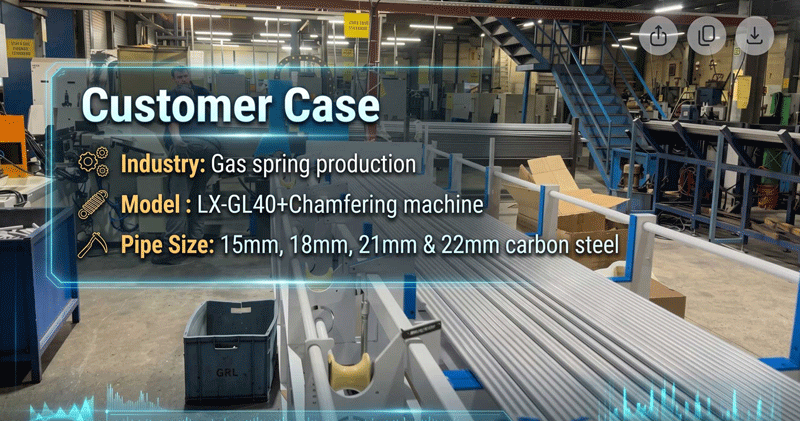
The customer’s primary tube specifications are:
Outer Diameters: Ø15 mm, Ø18 mm, Ø21 mm, and Ø22 mm carbon steel pipes
Cut Lengths: 150 mm to 500 mm (customized per industry application)
Wall Thickness: 1.0 mm to 2.0 mm
These small-diameter, high-volume requirements made our LX-GL40 high-speed laser tube cutting machine the ideal centerpiece
To eliminate human handling between processes, our engineering team leveraged rich automated integration experience from China to design an end-to-end continuous flow
High-Speed Fiber Laser Cutting Unit (LX-GL40): Precision high-speed tube feeding and cutting
Integrated Sorting & Transfer Conveyors: Automated transfer connecting the cutting unit directly to downstream stations
Two Customized Pipe Chamfering Machines: Specially designed dual-head chamfering stations linked directly via conveyor belts to handle high-speed continuous output without queuing
With this integrated cell, the laser tube cutting machines & chamfering machines | automated production line operates continuously without manual transfer: raw tubes are cut to length and automatically channeled into the chamfering stations for simultaneous internal and external end-finishing
After a full year of continuous, safe, and dependable operation on the customer’s factory floor
| Production Aspect | Conventional Sawing Setup (Before) | Automated Production Line (After) | Concrete Business Benefit |
| Material Flow | Disconnected batch steps (Cut ➔ Store ➔ Chamfer) | Synchronized single-piece inline flow | Minimum work-in-process (WIP) and zero transfer delays |
| Labor Demand | Multiple operators handling feeding, saws, & transport | Single-operator supervisory control | Substantial long-term savings in shop-floor labor costs |
| Tooling & Consumables | Continuous purchasing of circular saw blades & coolant | Non-contact laser optics; zero blade wear | Dramatic reduction in consumable costs & machine downtime |
| Shop Floor Logistics | 30+ separate machine footprints + buffer containers | Streamlined, compact continuous work cell | Reclaimed factory floor space and optimized warehousing logistics |

